
The Off-Page Playbook: An Honest Assessment of Off-Page SEO in 2026
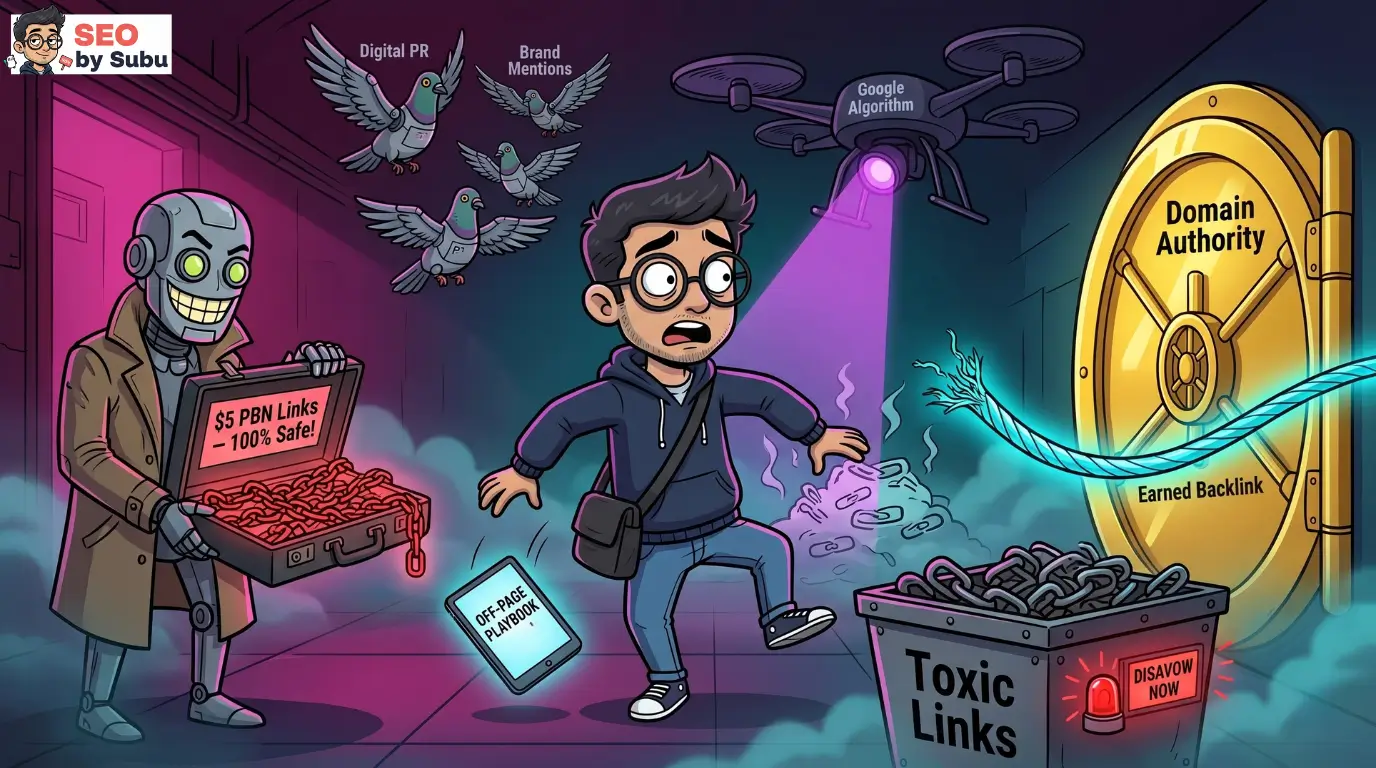
Replace YOUR-OFFPAGE-HERO-IMAGE-URL-HERE with your final hero image URL.
Subu is going to say something that most SEO agencies would never say on an off-page SEO pillar page.
Off-page SEO is the least important of the three SEO disciplines.
Not unimportant. Not irrelevant. But if you have a limited budget, limited time, and you are trying to decide where to focus first, off-page SEO comes after on-page SEO and after technical SEO. Every time. Without exception.
The reason the SEO industry does not say this often enough is partly commercial. Link building is a service that agencies charge significant monthly retainers for. It is easy to sell because backlinks used to be enormously powerful, and the residual belief in that power persists even as the reality has shifted considerably.
Here is what the reality looks like now.

“Off-page SEO comes after on-page SEO and after technical SEO. Every time. Without exception.”
What’s In This Guide
What Google Has Actually Been Saying
For years, Google stated that links were “an important factor” in determining the relevance of web pages. In March 2024, during the rollout of Google’s Spam Update, that language was quietly changed. The word “important” was removed. Links became simply “a factor.”
That is a small editorial change with a significant implication about Google’s direction of travel.
Google’s Gary Illyes, a member of the Search Relations team, has stated publicly that links have not been in Google’s top three ranking signals for some time and that the SEO industry significantly overestimates their importance. According to independent analysis of Google’s 2025 algorithm, backlinks account for approximately 13 percent of the ranking signal weight, down from 15 percent in 2024 and dramatically down from the era when links represented more than half of the entire algorithm.
For context on what 13 percent means in practice: consistent publication of satisfying, high-quality content accounts for approximately 23 percent of the ranking signal weight in the same analysis. The content and on-page work outweighs the link signal by a considerable margin.
The direction of travel is clear. Google has been systematically reducing the weight of links as a ranking signal as its AI systems have become capable enough to evaluate content quality and topical authority without needing other websites to do the job for them.
signal status: link-heavy assumptionsquality-signal calibrated
Hover or tap to visualize Google’s shift from link-heavy weighting toward broader quality signals

“Links became simply ‘a factor.’”
Why Google Reduced the Weight of Backlinks
The reason Google has been moving away from link dependency is straightforward: links can be bought. They always could be, but the link buying ecosystem has grown to an industrial scale. Private blog networks, guest post farms, link exchanges, and paid placement schemes mean that a significant proportion of the links on the internet are not genuine editorial endorsements at all. They are commercial transactions dressed up as editorial content.
Google’s spam detection systems have become substantially better at identifying manipulative link patterns, which means many of these purchased links are simply discounted or ignored rather than passing any ranking value. But the more important shift is structural. The more Google relies on links, the more incentive there is to manipulate them. Reducing that reliance reduces the manipulation incentive.
What Google has moved toward instead: content quality signals, topical relevance and authority, user engagement metrics, E-E-A-T (Experience, Expertise, Authoritativeness, Trustworthiness), and site-level quality signals. These are harder to fake at scale than links are.
spam-evasion status: manipulative systems activemanipulative systems discounted
Hover or tap to see manipulative link patterns lose value as quality signals become harder to fake
“The more Google relies on links, the more incentive there is to manipulate them.”
What This Means for a Practical SEO Programme
The priority order for any SEO programme, in Subu’s view, is this:
Technical SEO first. A website that cannot be properly crawled, indexed, and rendered cannot benefit from any other SEO work. Technical issues are the floor. Without a solid technical foundation, the content work and the off-page work produce a fraction of the results they should.
On-page SEO second. Content quality, keyword relevance, topical authority, internal linking structure, page experience signals. These are what Google’s algorithm is increasingly weighting. Getting these right is the majority of the ranking work for most websites in most competitive environments.
Off-page SEO third. A well-chosen selection of high-quality, genuinely relevant backlinks from authoritative sources. Not a high-volume link building programme. Not a guest posting farm. A small number of links that are genuinely good.
The businesses that get into trouble are the ones who skip to step three before steps one and two are in order. Subu has seen it repeatedly: a website with significant off-page investment and a fundamentally weak on-page and technical foundation that is not ranking competitively for anything it should rank for. The link building budget would have produced far more impact if it had been spent on content and technical work first.
programme state: sequence unclearsequence enforced
Hover or tap to reinforce sequence discipline before investing in off-page execution
“The businesses that get into trouble are the ones who skip to step three before steps one and two are in order.”
Where Backlinks Still Matter
None of this means backlinks are irrelevant. They are not. There are three specific scenarios where off-page signals genuinely move the needle.
Highly competitive niches where on-page signals are equal. When multiple well-optimised websites with strong content are competing for the same keywords, backlink authority can be the differentiating factor. In markets where the on-page signal is equally strong across several competitors, the site with stronger editorial link authority tends to rank above the others.
New domains establishing initial credibility. A brand new website with no backlink history has no external trust signals. A small number of genuine, authoritative links in the early months of a domain’s life can meaningfully accelerate the trust establishment that new sites need before Google starts ranking them competitively.
Brand authority and referral traffic beyond rankings. A mention and link in a respected industry publication, a national newspaper, or a relevant trade journal builds brand credibility with human readers as well as search engines. The referral traffic from high-authority links can be valuable independently of any ranking contribution.
The common thread across all three scenarios: it is about quality, not volume. A handful of genuinely earned, topically relevant, authoritative links does more for rankings than a hundred low-quality links from irrelevant or manufactured sources. The hundred low-quality links also carry real penalty risk if Google determines they are part of a manipulative link scheme.
impact scope: where links may helpwhere links can materially lift performance
Hover or tap to highlight the three cases where high-quality off-page signals still move rankings
“The common thread across all three scenarios: it is about quality, not volume.”
The Off-Page Playbook’s Purpose
Given all of this, the Off-Page Playbook exists for two reasons.
First, because some off-page activity is worth doing and worth doing properly. When you do pursue backlinks, guest posting, digital PR, or journalist outreach, the quality of execution matters enormously. Doing it wrong produces no benefit or active harm. Doing it right produces durable authority signals from sources that genuinely validate the content.
Second, because understanding off-page SEO helps you make informed decisions about what not to do. The link building industry is full of services promising volume, domain authority improvements, and ranking jumps that do not materialise or that introduce penalty risk. Understanding what actually moves the needle protects against wasting budget on tactics that do not.
Everything in this playbook is oriented toward the quality-first, execution-focused approach that produces genuine results rather than the volume-first approach that has been systematically devalued by Google’s algorithm changes over the past decade.
If your on-page and technical SEO foundations are not solid, read those pillars first. Come back to this one when the foundation is in place.
Read first: The On-Page Playbook
Read first: The Technical SEO Playbook
Read first: The On-Page Playbook Read first: The Technical SEO Playbook
execution model: volume-first campaignsquality-first authority building
Volume-First
outcome: temporary spikesoutcome: discounted patterns
Quality-First
outcome: slower buildoutcome: durable authority
Hover or tap to compare devalued volume tactics against durable quality-first execution
“Everything in this playbook is oriented toward the quality-first, execution-focused approach.”
The Off-Page Tactics This Playbook Covers
With that context established, here is what the Off-Page Playbook covers and the purpose each article serves in a properly sequenced off-page programme.
“The strategic map comes before tactical execution.”
What Are Backlinks and Why They Matter
The foundational article on how backlinks work, how Google evaluates them, and the specific quality attributes that determine whether a link carries genuine ranking value or none at all. Before pursuing any link building, understanding the quality framework is the prerequisite.
Read: What Are Backlinks and Why They Matter
Read the Full Guide: What Are Backlinks and Why They Matter ->link evaluation: raw authority transfercontextual relevance & intent checked
Hover or tap to shift from raw link count toward link quality qualification
“Understanding the quality framework is the prerequisite.”
Link Building Strategies (Overview)
The strategic map before the tactical detail. There are many link building tactics and not all are appropriate for every business, budget, or competitive context. This article covers the three broad strategic approaches, how to choose between them based on current authority and resources, and how to sequence tactics for the most efficient use of a limited link building budget.
Read: Link Building Strategies (Overview)
Read the Full Guide: Link Building Strategies (Overview) ->strategy execution: scattered tacticssequenced efficiency
Hover or tap to map tactics to authority stage and resource constraints
“The strategic map comes before the tactical detail.”
Guest Posting
Guest posting done properly, contributing genuinely useful original content to relevant, authoritative publications, remains one of the more reliable link acquisition tactics when executed with quality as the primary filter. This article covers how to identify the right publications, pitch effectively, and build a guest posting programme that prioritises editorial quality over volume.
Read: Guest Posting
Read the Full Guide: Guest Posting ->guest post standard: volume scalingeditorial contribution
Hover or tap to prioritize publication relevance and editorial quality in guest posting
“Guest posting done properly remains one of the more reliable link acquisition tactics.”
Digital PR for Links
A single piece of genuine editorial coverage in a high-authority publication produces more ranking value than most volume-based link building programmes. Digital PR is the highest-authority link channel available and the most underutilised by businesses without a PR background. This article covers how to approach it without a PR agency budget.
Read: Digital PR for Links
Read the Full Guide: Digital PR for Links ->PR mechanics: traditional outreachbroadcast & authority transfer
Hover or tap to model how one strong editorial hit can outperform volume campaigns
“A single piece of genuine editorial coverage can produce more ranking value than most volume-based programmes.”
Broken Link Building
Broken link building is one of the more value-aligned link acquisition tactics available. The site owner benefits from having a broken link fixed. The approach is covered here in full, from opportunity identification through to outreach and follow-up.
Read: Broken Link Building
Read the Full Guide: Broken Link Building ->broken link repair: 404 errorvalue-aligned replacement
Hover or tap to move from broken-link discovery to value-aligned replacement outreach
“Broken link building is one of the more value-aligned link acquisition tactics available.”
The Skyscraper Technique
Creating substantially better content than the most-linked-to piece on a topic and reaching out to the websites already linking to the original. A content-led link building approach with a clear, repeatable system.
Read: The Skyscraper Technique
Read the Full Guide: The Skyscraper Technique ->content strategy: benchmark averagesubstantially better asset
Hover or tap to upgrade a linked asset and pitch the improved version systematically
“A content-led link building approach with a clear, repeatable system.”
HARO and Journalist Outreach
Responding to journalist queries through HARO and its equivalents is one of the most accessible routes to high-authority editorial links for genuine subject-matter experts. This article covers how to respond in a way that gets selected.
Read: HARO and Journalist Outreach
Read the Full Guide: HARO and Journalist Outreach ->journalist request: generic pitch ignoredevidence-rich expert fit selected
Needs Expert
Hover or tap to convert journalist requests into authoritative editorial links
“HARO is one of the most accessible routes to high-authority editorial links for genuine experts.”
Anchor Text Optimisation
The anchor text of a backlink sends a relevance signal about what the linked page covers. Over-optimised anchor text profiles are one of the clearest patterns that triggers algorithmic and manual penalties. This article covers how to audit the current anchor text distribution and keep it in a natural, safe range.
Read: Anchor Text Optimisation
Read the Full Guide: Anchor Text Optimisation ->anchor profile: exact match heavy (toxic)penalty-safe natural balance
Hover or tap to rebalance anchor distribution toward a natural, safer profile
“Over-optimised anchor text profiles are one of the clearest patterns that triggers penalties.”
Toxic Links and Disavow
Some backlinks actively harm rankings. Identifying them, assessing them accurately, and using Google’s Disavow Tool correctly when necessary is the defensive component of backlink management that most sites with any history of link building need to understand.
Read: Toxic Links and Disavow
Read the Full Guide: Toxic Links and Disavow ->link cleanup: toxic patterns passing riskdefensive disavow active
Hover or tap to classify harmful backlinks before defensive disavow action
“Using Google’s Disavow Tool correctly is a defensive component most sites need to understand.”
Competitor Backlink Analysis
Analysing the backlink profiles of competitors already ranking for target keywords reveals pre-qualified link opportunities. Sources that have already linked to competitors have demonstrated willingness to link in the same topical space. This article covers how to turn competitor analysis into a prioritised link building target list.
Read: Competitor Backlink Analysis
Read the Full Guide: Competitor Backlink Analysis ->competitor analysis: blind outreachintersecting gap opportunities
Gap
Hover or tap to turn competitor backlink gaps into a focused outreach queue
“Sources that already linked to competitors are pre-qualified opportunities in the same topical space.”
Resource Page Link Building
Resource pages are curated collections of external links on specific topics. For content that genuinely belongs in a well-curated resource, getting listed is a straightforward, value-aligned link building opportunity. This article covers how to find them and pitch for inclusion effectively.
Read: Resource Page Link Building
Read the Full Guide: Resource Page Link Building ->resource placement: irrelevant link begperfect fit value alignment
Hover or tap to qualify resource-page fit before requesting inclusion
“Getting listed is a straightforward, value-aligned link building opportunity.”
Brand Mentions and Unlinked Mentions
Every unlinked brand mention online is a potential link that already has a warm relationship behind it. The writer knows the brand. The ask is a small editorial addition. Converting unlinked mentions to links is one of the highest-conversion link building activities available.
Read: Brand Mentions and Unlinked Mentions
Read the Full Guide: Brand Mentions and Unlinked Mentions ->unlinked mention: static brand textwarm relationship conversion
Hover or tap to convert unlinked mentions into links with warm editorial context
“Converting unlinked mentions to links is one of the highest-conversion link building activities available.”
Link Building Outreach Templates
The outreach message is where most link building programmes fail. Generic, self-serving pitches get deleted. Personal, specific, value-oriented messages get responses. This article covers the structural principles and specific templates for every link building tactic in this playbook.
Read: Link Building Outreach Templates
Read the Full Guide: Link Building Outreach Templates ->outreach template: templated spam blastpersonalized value-forward ask
Hover or tap to replace generic pitches with specific, value-oriented outreach structure
“Generic, self-serving pitches get deleted. Personal, specific, value-oriented messages get responses.”
TL;DR (You Know the Drill)
- Off-page SEO is the third priority in a properly sequenced SEO programme, behind technical SEO and on-page SEO. Get those foundations right first
- Google has been systematically reducing the weight of backlinks as a ranking signal. Gary Illyes from Google has stated links have not been in the top three ranking signals for some time. In March 2024, Google quietly changed their documentation language from links being “an important factor” to simply “a factor”
- Independent analysis puts backlinks at approximately 13 percent of Google’s ranking signal weight in 2025, down significantly from the era when links dominated the algorithm. Content quality now outweighs links in the signal picture
- The primary reason Google has reduced link weight: links can be bought at scale, which made them a manipulable signal. Google’s AI systems can now evaluate content quality more directly without relying on other websites to do it
- Where backlinks still matter: highly competitive niches where on-page signals are equal across competitors, new domains establishing initial trust, and brand authority development beyond pure ranking impact
- Quality is the only rule that matters in link building in 2026. A small number of genuinely earned, topically relevant, authoritative links outperforms a large volume of low-quality ones and does not carry the penalty risk that volume-based link building carries
        •        Off-page SEO is the third priority in a properly sequenced SEO programme, behind technical SEO and on-page SEO. Get those foundations right first
        •        Google has been systematically reducing the weight of backlinks as a ranking signal. Gary Illyes from Google has stated links have not been in the top three ranking signals for some time. In March 2024, Google quietly changed their documentation language from links being “an important factor” to simply “a factor”
        •        Independent analysis puts backlinks at approximately 13 percent of Google’s ranking signal weight in 2025, down significantly from the era when links dominated the algorithm. Content quality now outweighs links in the signal picture
        •        The primary reason Google has reduced link weight: links can be bought at scale, which made them a manipulable signal. Google’s AI systems can now evaluate content quality more directly without relying on other websites to do it
        •        Where backlinks still matter: highly competitive niches where on-page signals are equal across competitors, new domains establishing initial trust, and brand authority development beyond pure ranking impact
        •        Quality is the only rule that matters in link building in 2026. A small number of genuinely earned, topically relevant, authoritative links outperforms a large volume of low-quality ones and does not carry the penalty risk that volume-based link building carries
This is The Off-Page Playbook, Pillar 6 of SEO by Subu.
Read the On-Page Playbook and the Technical SEO Playbook before this one if you have not already.
Subu, SEO by Subu
“Quality is the only rule that matters in link building in 2026.”