
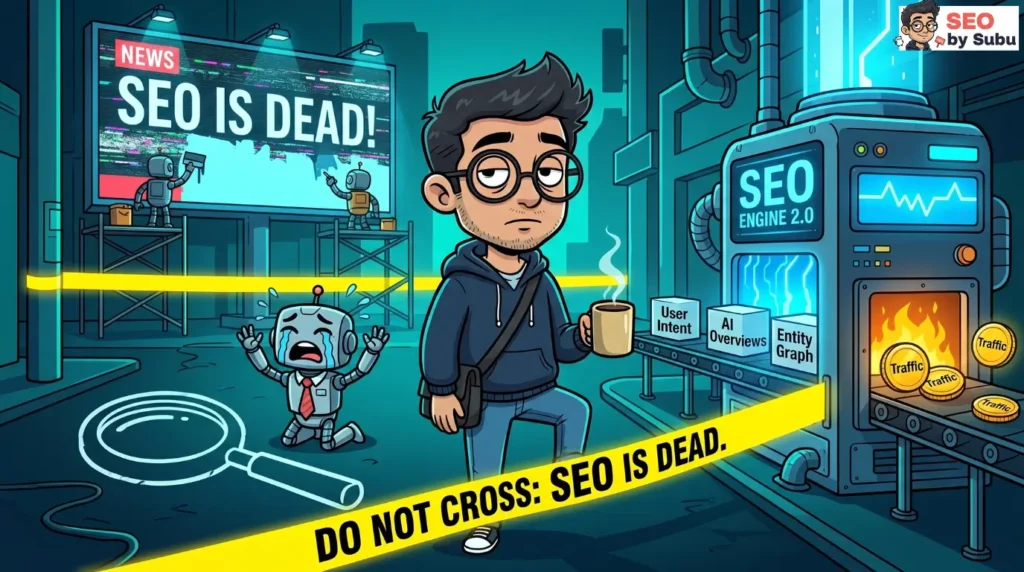
Here’s the thing about declaring SEO dead: it’s basically a tradition at this point.
SEO was born in July 1997 when a spammer used the term in a newsgroup, which is honestly a perfect origin story and it was declared dead for the first time the same year.
Not by someone who hated it. By someone who simply thought search engines were pointless technology that nobody would ever care about.
Google launched that same year.
So no, the death-callers don’t have a great track record. But that doesn’t mean we should dismiss what’s happening right now. We’ll get to that.
First, the history. Not the comic-strip version the actual version, with the parts most people get wrong.
Table of Contents
The Death Notices: A Corrected Record
1997 — “Search is a dead end”
Richard Hoy didn’t declare SEO dead. He declared search engines dead. His reasoning: too complex, too unreliable, too full of misleading results. His advice to clients was to set their meta tags and forget it.
This was, to put it mildly, a bad call. AltaVista was already serving 20 million queries a day, and two Stanford students were about to build something called Google. The lesson from 1997 isn’t that someone called SEO dead. It’s that even smart people, staring directly at a massive shift, will declare it a dead end right before it reshapes everything.
Keep that in mind the next time someone says AI search is just a fad.
2003 — Florida: When Google Got Serious
On November 16, 2003, right before Christmas, because Google has no chill, the Florida update dropped. Sites that had ranked for years vanished overnight.
The popular version of this story is “Florida killed keyword stuffing.” The real version is messier: Florida was primarily a link analysis change, and it caught plenty of legitimate sites in the crossfire too. SEO forums in December 2003 looked like the aftermath of a natural disaster. People were confused, angry, and had no idea how to recover.
What Florida actually killed was the era of gaming Google with no consequences. It was the moment Google announced, without words, that it was going to be a moving target forever.
2011–2012 — Panda and Penguin: The Double Hit
Panda (February 2011) went after content farms: sites churning out thousands of low-quality articles for search engines, not humans. It affected 11.8% of all US search queries in the first rollout. Demand Media, a billion-dollar company built on the content-farm model never recovered. The term “content marketing” as we know it was essentially invented in Panda’s aftermath, because the industry needed a new name for doing the thing it should have been doing all along.
Penguin (April 2012) went after link manipulation: link farms, paid links, private blog networks, over-optimised anchor text. Entire SEO agencies built on link packages had nothing left to sell by Monday morning.
Together, these two updates killed a decade of shortcuts in about 18 months.
2013 — Hummingbird: The Quiet Revolution
This is the one most “SEO is dead” roundups skip, and it’s the most important structural change in this whole list.
Google didn’t update its algorithm in 2013. It replaced it. Hummingbird was a full rewrite of the core search engine, shifting from keyword matching to semantic understanding trying to grasp the intent behind a query rather than just pattern-matching words. This is where “write for your audience, not for search engines” stopped being motivational poster content and became an actual ranking consideration.
2015 — Mobilegeddon and RankBrain
Two separate things that people keep lumping together.
Mobilegeddon (April 2015): made mobile-friendliness a ranking factor but only for mobile search. Desktop rankings were untouched. Google gave two months’ notice before it went live, which is essentially search-algorithm parenting at its most patient.
RankBrain (October 2015): the first time Google confirmed that artificial intelligence was directly influencing its rankings. A machine learning system that processed novel and ambiguous queries. Google said it was already its third most important ranking factor when they announced it. Most of the industry shrugged.
They probably should have paid more attention.
2022–2023 — The Helpful Content Update: The Chapter Nobody Talks About Enough
Here is the most brutal thing Google has done to publishers since Panda, and it barely registers in most “SEO is dead” histories.
The Helpful Content Update (HCU), launched in August 2022 and reloaded with ferocity in September 2023 applied site-wide classifiers. Not page penalties. Site-wide quality signals. If Google decided your site existed primarily to serve search engines rather than people, the whole domain was downgraded.
Among 671 travel publishers analysed post-update, 32% lost more than 90% of their organic traffic. Not a dip. Not a correction. Ninety percent. Sites that had been building audiences for years were effectively deleted from search results.
Sites that have “recovered” from HCU typically see about a third of their original traffic return. That’s considered a win.
Google held a private meeting with impacted publishers in late 2024. By one attendee’s account: clear admissions that quality content was being penalised, no clear path to recovery, and, in their words, “lashings of PR gobbledegook.”
The HCU is not over. Its signals were baked into Google’s core algorithm in March 2024. If you work in content and this chapter is new to you, it should not be.
2024 — AI Overviews: The One That’s Actually Different (Sort Of)
Google rolled out AI Overviews to all US users in May 2024. When they appear, organic click-through rates for informational queries have dropped 61%. Chegg lost 49% of non-subscriber traffic in a single year and filed an antitrust lawsuit against Google.
But here’s what the panic headlines leave out.
AI Overviews appear in roughly 4–12% of all search queries. They disproportionately hit informational searches — “how to” and “what is” content. Transactional and navigational searches are largely unaffected. And 97% of citations within AI Overviews come from the top 20 organic results. If you rank, you can still be the source. The relationship between ranking and traffic has shifted. The value of ranking has not disappeared.
What has changed is the mix. Organic impressions are holding steady or growing for many sites. Clicks are falling. You can rank first and get fewer visitors than you did two years ago. That’s a real problem. It just needs a real solution, not a gravestone.
Why This Time Is Actually Different (A Little Bit)
Every death before this one followed the same pattern: Google updates, shortcuts die, fundamentals survive, industry adapts, moves on. The channel itself never changed.
What’s happening now has an additional layer that previous cycles didn’t: the channel is structurally shifting.
In March 2025, Google’s share of global search dipped below 90% for the first time in over a decade. ChatGPT, Perplexity, and AI assistants are changing search habits for a real and growing subset of users — particularly for research and discovery queries. Social search (TikTok, Reddit, YouTube) has been eating into informational search for years.
Google isn’t just updating its algorithm. It’s defending its business model.
That changes the game somewhat. Not because SEO is dead — it isn’t — but because “rank on Google, get clicks” is no longer the whole playbook. The people who treated SEO as a single-channel traffic machine are the ones who are actually in trouble. Everyone else is adapting.
What Still Works (And Why It Always Did)
Here is the whiteboard that has not changed in 25 years:
Crawlability. If Google can’t find and read your pages, none of the rest matters. This is not glamorous. It is non-negotiable.
Content with real expertise. Post-HCU, Google’s tolerance for information arbitrage — “I researched what experts say and summarised it” — is near zero. The sites that are holding are the ones written by people who actually know the thing they’re writing about.
Earned authority. Links and brand signals that aren’t manufactured. Harder to build. Impossible to fake at scale for long.
Technical health. Speed, structure, schema, clean architecture. Table stakes that are somehow still not table stakes for most sites.
User experience. Google measures what people do after they click. If they bounce, you’re paying a ranking penalty you never see in a spreadsheet.
The tactics on top of this framework change constantly. The framework itself has been stable since 2003.
What’s Next: The Uncomfortable Honest Version
SEO is not going away. But the version of SEO built entirely on “rank on Google, get traffic” is facing real structural pressure for the first time and not just tactical pressure.
Here’s what actually matters going forward:
Visibility over traffic. The metric is shifting. Getting cited in an AI Overview with no click still matters for brand authority, trust, and the downstream searches it generates. Obsessing over clicks alone misses this.
Topical authority, not topical volume. The HCU killed the “publish 300 articles across every keyword variation” model. What’s working now is depth and genuine expertise in a defined space. Fewer pages. More authority. More signal.
Multi-surface presence. The people winning aren’t just ranking on Google. They’re being cited in AI answers, referenced in Reddit threads that rank, appearing in YouTube search, building brand recognition that creates direct search intent. “SEO” as a category is widening, not dying.
The brand signal is the moat. Google has been increasingly favouring brands over anonymous authority sites for years. The HCU accelerated this. If people search for you by name: your brand, your product, your newsletter that is a signal that no algorithm update can take away. It’s also the hardest thing to build and the most durable asset in search.
The agencies and practitioners who are thriving right now are not the ones who rebranded SEO as “Quantum Discoverability” and updated their pitch decks. They’re the ones who looked at where Google is trying to send users to sources with real expertise, real authority, real brand recognition and decided to actually become that.
So Here’s The Actual Answer
Is SEO dead?
No. But the easy version is.
The version that was keyword research → content → links → rankings → traffic → repeat, at industrial scale, with no genuine expertise required at any step, that version is on life support, and the HCU plus AI Overviews are the double diagnosis.
The version built on genuine expertise, real authority, and understanding what users actually want from search, that one is fine. It’s actually better than ever, because most of the competition just got wiped out.
That’s the pattern, by the way. It has held across every single one of these “deaths.”
Every update Google has ever shipped, without exception, has been an attack on shortcuts. Every time, the people who were taking shortcuts lost. Every time, the people doing the actual work found the playing field less crowded.
The graveyard is real. It’s just full of tactics, not disciplines.
SEO isn’t in the graveyard. It built the graveyard.
