
The AI Search Playbook: How to Stay Visible When Search Is No Longer Just Google
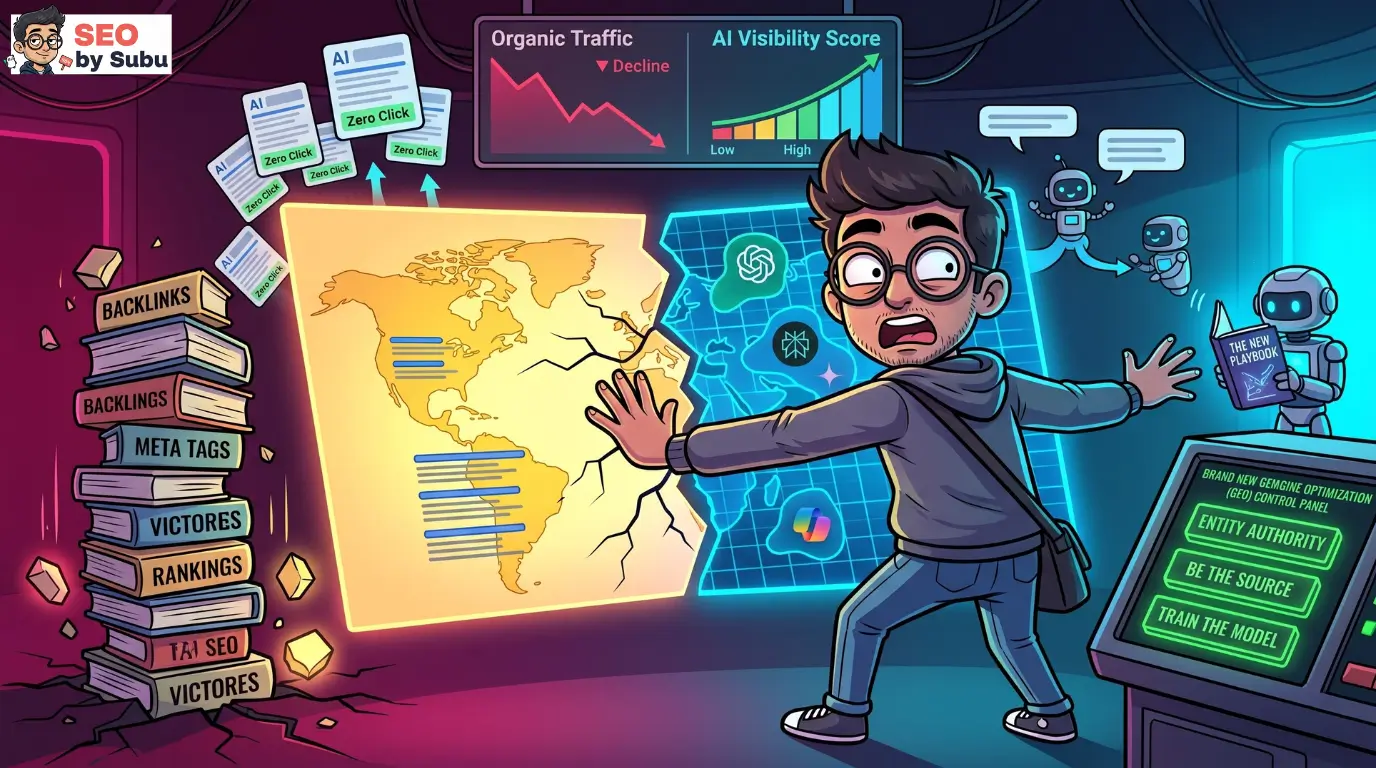
Let’s start with the thing nobody in SEO wants to say out loud.
The game changed. Not slowly, not gradually, not in ways you could ease into. It changed fast, it changed structurally, and if you are still running the same content strategy you were running in 2023, you are not just behind you are optimising for a search engine that no longer fully exists.
In 2026, 64.82 percent of Google searches end without a single click to any website. On mobile, that number is 77.2 percent. For queries where Google triggers an AI Overview, the median zero-click rate hits 80 percent. Users are not clicking blue links. They are reading AI-synthesised answers directly on the results page and moving on with their lives.

Google doesn’t rank your feelings. ChatGPT doesn’t care how many hours you spent on your brand voice guidelines. Perplexity’s XGBoost reranker has a quality threshold and your content either clears it or it doesn’t.
Meanwhile, AI traffic is growing at a rate that makes traditional SEO growth look pedestrian. AI search traffic increased 527 percent in a single year. ChatGPT, Perplexity, Claude, and Google’s AI Mode are collectively handling an enormous and rapidly growing share of the questions your audience used to ask Google and then click through to your content to answer.
This is not a crisis. It is a transition. And transitions punish people who refuse to adapt while rewarding people who understand the new mechanics early.
The mechanics have changed fundamentally. You are no longer optimising for a human to click a link and read your page. You are optimising to be the source an AI system trusts enough to cite. That is a different goal. It requires a different strategy. And it starts with understanding that the entity making the decision about whether to use your content is no longer a human being comparing search results. It is a machine evaluating fact density, entity clarity, structural formatting, domain authority, and topical consensus.

This playbook is the survival guide. Fifteen cluster articles. Every mechanic that matters. No padding, no theory, no “SEO is evolving” filler that says nothing. Pick the section that describes your current problem. Go deep. Fix it.
What’s In This Guide
1. How AI Search Works: Google AI Overviews, ChatGPT, and Perplexity
Understanding why your content is or is not being cited starts with understanding that these three systems work completely differently.
Treating them as interchangeable is one of the most common and most expensive mistakes in GEO right now.
Google AI Overviews: the query fan-out machine.
When a user types a query that triggers an AI Overview, Google does not simply retrieve the top result and summarise it. It runs what is called a query fan-out it decomposes the original query into multiple related sub-queries and retrieves sources across all of them simultaneously. The pages that appear most consistently across those sub-query results are the ones that end up cited in the Overview.
Hover or tap to run the fan-out algorithm and see who wins the citation
This changes the targeting strategy entirely. A page that ranks brilliantly for one specific long-tail query may be less likely to get cited than a page that covers a topic comprehensively enough to appear across multiple related sub-queries. Depth and breadth within a topic matter for AI Overview citation in a way they did not for traditional ranking.
AI Overviews appear on approximately 13 percent of all queries as of early 2026, with BrightEdge measuring them on 48 percent of searches by February 2026 up 58 percent year on year. They predominantly trigger for informational and complex queries. Purely transactional queries like “buy laptop” or “order pizza” rarely trigger them. Google is not going to cannibalise its own ad revenue by answering commercial intent queries with an AI summary.
What Google selects as AIO sources has also shifted. Multiple 2025 studies showed a correlation between top-10 organic rankings and AIO citation, but this relationship has weakened since Google upgraded AI Overviews to Gemini 3 in January 2026. Domain-level authority still matters significantly, but the fan-out process means that pages outside the top 10 for a primary query can be cited if they rank well for sub-queries within the same topic.
The practical implication: topical authority across a content cluster is more valuable for AIO citation than a single high-ranking article.
Perplexity: the three-layer quality gate.
Perplexity retrieves candidates from a hybrid index combining Bing’s web index with its own internal cache. Every page in that candidate pool then passes through three stages of evaluation. The first two layers handle semantic relevance and initial filtering. The third layer is the one that matters for GEO strategy: an L3 XGBoost machine learning reranker that scores each source against approximately 59 ranking signals including semantic depth, domain trust, content freshness, and engagement patterns.
A quality threshold determines which sources clear the gate entirely. Sources that fail the threshold are dropped from consideration regardless of how well they performed in earlier layers. Perplexity also maintains manually curated authority domain lists that give algorithmic preference to sources referenced by or associated with high-authority platforms including GitHub, Reddit, LinkedIn, and Amazon. Being cited in those environments is a direct trust signal that influences Perplexity visibility.
The practical result: Perplexity rewards content that opens with a direct, specific, factual answer before elaborating. It rewards original data and expert-attributed claims. It penalises outdated content through a time-decay curve that reduces visibility for pages that have not been recently updated. It is not interested in your introduction, your brand story, or the four paragraphs of context you wrote before getting to the actual answer.
ChatGPT: the consensus aggregator.
ChatGPT’s web browsing capability, when enabled, approaches source selection through a different lens. It looks for consensus what does the collective authoritative internet say about this topic? Rather than primarily evaluating individual page quality, it weighs what multiple authoritative sources agree on.
This means the third-party ecosystem matters as much as your own website. Reddit discussions about your product category. G2 and Capterra reviews. Industry roundup articles that include or exclude your brand. High-authority listicles. If you claim your product is the best but authoritative third-party sources suggest otherwise, ChatGPT will surface the consensus view, not your marketing copy.
The internet always wins the argument against your own website. For ChatGPT to be able to surface your content at all, your robots.txt must allow the OAI-SearchBot crawler. Block it and you do not exist in ChatGPT’s web-browsing results. No exception, no workaround. Check your robots.txt right now.
2. How Google AI Overviews Select Sources
The source selection process for AI Overviews is the one people most want a clean answer to and the one that has the messiest, most nuanced reality.
Here is what the current research actually shows rather than what a 2024 blog post told you.
Hover or tap to run the AI extraction scanner
The top-10 organic ranking correlation is real but weakening.
Multiple independent studies from 2024 and early 2025 found that a significant majority of AI Overview citations came from pages that also ranked in the top 10 organically for the same query.
SE Ranking found an 84.72 percent correlation at domain level.
IdeaHills found 67 percent of AIO links were in the top 10 at URL level.
But the Ahrefs March 2026 study found that citations from top-ranking pages dropped sharply following Google’s upgrade of AI Overviews to Gemini 3. The relationship is not broken but it is less deterministic than it was.
The fan-out process, where Google decomposes queries into sub-queries and cites pages that appear across multiple sub-query results, means that pages outside the strict top 10 for a primary query now have a legitimate path to AIO citation if they have topical authority across the broader subject area.
The practical implication: strong baseline SEO is still the foundation. Pages that cannot rank at all have no realistic path to AIO citation. But optimising purely for the primary keyword without building comprehensive topical coverage is increasingly insufficient for sustained AI Overview visibility.
Intent gates AI Overview triggers.
AI Overviews appear for informational and complex queries. They do not regularly appear for transactional queries where commercial intent is primary.
This means the content types with the most AI Overview visibility are definitional content, how-to guides, comparative content, research summaries, and FAQ-format responses.
The product page optimised for “buy [product] online” is not competing for AI Overview citation.
The blog post explaining how to evaluate that product category is.
E-E-A-T is the trust filter, not a ranking trick.
Google’s source selection for AI Overviews gives significant weight to E-E-A-T signals.
Not as a gaming target but as a genuine quality filter.
The Google August 2025 Spam Update specifically targeted sites generating scaled AI content with no original human expertise, no real author credentials, and no demonstrated first-hand experience.
Sites caught in that update saw dramatic drops in both organic rankings and AI Overview citation rates simultaneously.
A domain that demonstrates real author expertise through verified credentials, backs claims with authoritative sources, and shows evidence of genuine first-hand experience is structurally more likely to be cited in AI Overviews than a domain producing credibly-formatted content that is actually hollow.
The signal that distinguishes them is not format. It is depth. It is originality.
It is the specific detail that could only come from someone who actually did the thing they are writing about.
Structural formatting improves extraction probability.
Even when a page meets the quality threshold for AIO consideration, how the content is structured affects whether the AI can cleanly extract a citable passage from it.
AI Overview sources are more likely to come from pages that use explicit question-based headings, structured answer passages in the first two sentences after each heading, and formatted lists or tables for comparative or multi-step information.
This is not because Google’s algorithm is simply matching heading text to queries.
It is because structured content is easier for the AI to extract cleanly as a citable passage without hallucinating or misrepresenting the source material.
A page that buries the answer to its primary question in paragraph four of a long introductory section is structurally harder for AI to cite than a page that answers the question in the first sentence after the H2.
Both pages might rank identically in organic search. Only one gets cited in the AI Overview.
3. Optimising Content for AI Overviews
Every word here is about the practical rewrite, not the theory. If you have read this far and want someone to summarise research at you, there are approximately nine thousand blog posts that will do that. This section is about what to actually change in your existing content.
Hover or tap to invert the pyramid and clear the AI quality threshold
Answer first. Context second. Always.
The single most impactful structural change you can make to existing content is moving the answer to the first one or two sentences after each heading. Not the second paragraph. Not after the context setting introduction. The first sentence.
AI extraction works by identifying the most concise, accurate, self contained passage that answers the question implied by the surrounding heading. If that passage is in sentence one, the AI can cite it cleanly. If it is in sentence four after three sentences of setup, the AI either skips the page or extracts a garbled version that misrepresents the source.
Go through your highest traffic informational pages right now. For every H2 and H3 subheading, ask: does the very first sentence after this heading directly answer the question in the heading? If the answer is no, rewrite it so that it does.
This is a one afternoon project on most sites and it is one of the highest leverage AIO optimisation actions available.
Fact density over adjective density.
The claim “many users saw significant improvements after implementing this strategy” is useless to an AI system. It is vague, unverifiable, and provides no anchor for factual extraction. The AI will not cite it.
The claim “in Semrush’s 2025 study, 63 percent of businesses reported improved organic visibility after AI Overviews rolled out” is specific, attributable, and factually verifiable. The AI can extract it with confidence because it can verify the source, the number, and the context.
Every piece of informational content needs specific, attributed, verifiable data points woven through it. Not marketing assertions. Not vague summaries. Actual numbers with actual sources. Each data point acts as an anchor for AI extraction.
The more anchors a page has, the more extractable it becomes across multiple related queries. This is why original research, proprietary data, and cited external studies are disproportionately cited in AI Overviews relative to equally well written pages that contain no specific verifiable claims.
Question based H2 and H3 headings.
Google’s fan out process decomposes queries into sub queries and retrieves sources for each. The headings on your page are one of the primary signals the AI uses to evaluate whether your page is relevant to a specific sub query.
A heading that reads “Benefits of Structured Data” is less specific than “What Does Structured Data Do for AI Search Visibility?” The second heading explicitly maps to the type of question a user might ask a conversational search engine. It also tells the AI precisely what the following passage answers.
Rewrite generic topic headings as explicit questions whenever the content is answering a question rather than describing a topic. This is not keyword stuffing. It is structural alignment between your content’s purpose and the query format that AI systems process.
Three to five FAQ questions per important page, formatted cleanly.
FAQ sections are not a vintage SEO technique due for retirement. They are one of the most effective AI citation formats available in 2026. A well structured FAQ with specific, concise answers to common questions on the topic is essentially a pre formatted extraction target for AI systems. Each FAQ item is a self contained question answer unit that the AI can directly cite.
Write FAQ questions in the natural language your audience actually uses. Not “What are the benefits of [service]?” but “Is [service] worth it for a small business?” Answer each FAQ in two to four sentences maximum. The goal is a complete, specific, non hedged answer that stands alone without requiring surrounding context.
4. Structured Data for AI Search
If the previous section was about making your content readable for humans and extractable for AI, this section is about speaking directly to the machines in their native language. Structured data in 2026 is not optional SEO hygiene. It is the difference between an AI system confidently citing your page as a source and an AI system ignoring your page because it cannot verify the claims on it.
“name”: “TrailMaster 3000”,
“price”: “120.00”,
“rating”: “4.9”,
“status”: “InStock”
}
Hover or tap to translate prose into verifiable machine facts
Why structured data matters specifically for AI citation.
AI systems face a fundamental reliability problem. They are generating answers that users trust as factual. If they cite a source that turns out to be incorrect, it damages the system’s credibility.
The way they manage this risk is by preferring sources where claims can be independently verified. Structured data is one of the primary verification mechanisms. A product page with validated JSON LD schema explicitly tells the AI: this is a product, here is its name, here is the price as of this date, here is the verified review aggregate, here is the organisation that makes it.
The AI does not have to infer any of this from the page content. It is structured, machine readable, and verifiable against the Knowledge Graph. That reduces the AI’s risk in citing the page and increases citation probability.
The schema types that matter most for AI search in 2026.
- Organization schema on every page: Not just the homepage. Every page should associate itself with a verified organisation entity. Include your name, logo URL, and official website. This entity association helps AI systems confirm that your domain is a real, identifiable organisation rather than an anonymous content site.
- Article and NewsArticle schema for editorial: Include author name linked to a Person schema, published date, modified date, and publisher. The author to Person entity link is increasingly important for E E A T verification.
- FAQPage schema: This directly feeds question answer pairs into the AI’s structured data layer. Google can extract FAQPage schema content without even processing the surrounding page content.
- Product schema with Return and Shipping: These nested objects are now required for AI shopping agent compatibility. Availability must use Schema.org vocabulary. Price must be numeric.
- HowTo and Breadcrumb schema: HowTo gives AI systems a structured list of steps to cite for procedural queries. Breadcrumb schema communicates site hierarchy, helping the AI understand topical context.
What to fix right now.
Go to Google’s Rich Results Test. Run your three most important informational pages through it. Look specifically for:
One: any field showing a validation error. Broken schema provides no citation benefit. Two: availability values outputting as plain text strings. Three: missing author entity on Article schema. Four: duplicate schema blocks from multiple sources. search for application/ld+json in your source code.
5. Conversational Content and Question Based Formats
Here is the query that changed everything for a client of mine last year. They ran a D2C supplement brand. Solid Google rankings on a handful of product-adjacent informational terms. They came to me because their organic traffic had plateaued despite consistent content output and solid on-page work.
Hover or tap to apply the structural rewrite and clear the AI extraction gate
I pulled their Search Console data and filtered for queries driving impressions from AI Overview appearances. Zero. Their content was generating zero AI Overview impressions. I looked at how their content was structured. Every article opened with a three-paragraph brand story. The actual answer to the question in the title appeared somewhere around paragraph six.
Headings were topic labels: “Magnesium and Sleep,” “Benefits of Ashwagandha,” “Understanding Cortisol.” Not questions. Labels. Meanwhile, the queries their audience was sending to ChatGPT and Google’s AI Mode were things like: “what magnesium type is best for sleep and anxiety at the same time” and “can I take ashwagandha if I have high cortisol in the morning.” Full sentences. Conversational intent. Specific circumstances baked into the question itself.
Their content had the answers. It just was not structured in a way that let any AI system find them, extract them, or confidently cite them. The rewrite took two weeks. Headings became questions. Answers led every section. FAQ sections with natural-language questions got added to each article. Within eight weeks, AI Overview impressions went from zero to appearing on 23 of their target queries. The content had not changed. The structure had.
Why search queries are now conversational and why that rewrites your formatting strategy.
Voice search, AI assistants, and the normalisation of talking to search engines like ChatGPT have fundamentally changed the average query structure. Users no longer type “running shoes knee pain.” They ask “what are the best running shoes for someone with bad knees who runs on trails?”
These are not the same query. The second one carries context, specificity, and a scenario that a good answer needs to address directly. The first one is a keyword. The second one is a question looking for a real answer. AI systems are specifically built to process the second format. They parse the question, identify the intent and the constraints within it, and look for sources that address the full question rather than just the surface keyword.
Content that is written as a direct answer to a specific, conversational question is structurally easier for an AI to cite than content written around a keyword.
The structural rewrite: what changes and what does not.
The goal is not to make your content sound like a chatbot wrote it. Subu’s voice, short punchy paragraphs, dry wit, directness all of that stays. What changes is the architecture underneath the voice.
- Question-based headings for every section that answers something. A heading that reads “Keyword Research in 2026” is a topic label. A heading that reads “Is Traditional Keyword Research Dead in 2026?” is a question that maps directly to what users are asking AI systems. The content under both headings can be identical. But the second heading tells the AI immediately: this section answers this specific question. Not every heading needs to be a question. Sections that introduce, connect, or provide narrative context can stay as statements. But every section that answers something the user came to the page to find out should be a question that matches the natural-language version of that thing.
- Answer in the first sentence. Every time. This has been mentioned in the AI Overviews section and it bears repeating here because it is the most consistently missed structural fix on informational content across the web. The first sentence after a question-format heading is the extraction target. The AI looks at the heading, evaluates the first sentence or two of the following content, and decides whether this passage cleanly answers the question. If it does, it is citation-eligible. If the first sentence is context-setting, narrative, or transitional, the AI either moves on or extracts something garbled from further down the section.
- Chunk content into 120 to 180 word sections. Long unbroken sections of prose are hard for AI systems to extract from cleanly. When the relevant answer is embedded in 400 words of flowing text, the AI has to decide where the answer starts and ends. That decision introduces the risk of a garbled or incomplete extraction. Breaking content into sections of 120 to 180 words, each answering one specific sub-question, gives the AI clean, bounded extraction targets. Each section is self-contained enough to be cited independently. The sections string together for human readers into a coherent argument. For AI systems they are a library of citable passages organised by sub-question.
The format that works: heading as a question, first sentence as a direct answer, following sentences as the explanation, evidence, and nuance. This is not dumbing down the content. It is inverting the pyramid that most writers were taught to build right-side up. The conclusion goes first. The supporting argument follows.
FAQ sections: the most reliable AI citation format available.
A properly structured FAQ section is essentially a pre-formatted extraction table for AI systems. Each FAQ item is a self-contained question-answer pair. The AI does not need to parse surrounding context. It does not need to evaluate where the answer starts. It reads the question, reads the answer, and either cites it or moves on.
Write FAQ questions in the exact natural language your audience uses when asking AI systems. Not “What are the SEO benefits of structured data?” but “Does structured data actually help you rank in 2026?” Keep answers to two to four sentences. Direct, complete, non-hedged. If the answer requires more than four sentences to be accurate, it belongs in a full section of its own, not in a FAQ.
Aim for five to eight FAQ questions per page on informational content. Place the FAQ section near the bottom of the page after the main content has established the full context, but before the CTA and sign-off. This placement means users who read straight through see the FAQ as a useful summary, while AI systems parsing the page find a clean, structured extraction target regardless of where they start processing.
6. How to Rank in Perplexity and ChatGPT Search
These are different platforms with different architectures and different citation logics. Treating them identically is the single fastest way to underperform on both.
Hover or tap to run the distinct algorithmic scans
Perplexity: clear the quality gate or do not exist.
Perplexity’s three layer retrieval and reranking system covered in section one has a quality threshold that pages either clear or do not. The XGBoost reranker at the third layer scores pages against approximately 59 signals. Understanding which of those signals are within your control is what makes Perplexity optimisation tractable.
- Passage clarity and answer first structure: Perplexity extracts passages, not pages. The passage that gets cited is usually the first clear, specific, factual statement following a heading that matches the user’s query. This maps directly to the structural advice in the previous section.
- Content freshness is not optional: Perplexity has a documented time decay preference that reduces citation probability for content that has not been recently updated. This is not about publishing new articles constantly. It is about systematically revisiting and updating your most important existing content. Add the latest data. Update statistics that have aged out. Remove references to things that have changed. Mark the updated date in the Article schema dateModified field. Perplexity’s crawlers read that field and weight it in the freshness signal.
- Domain trust through third party authority association: Perplexity maintains curated domain authority signals that give preference to sources associated with high authority platforms. Being cited in GitHub documentation, Reddit communities with high karma, LinkedIn articles from verified professionals, and Amazon product reviews all contribute to the trust signals that Perplexity’s algorithm uses to evaluate your domain. This is off page work that operates outside your own site entirely.
- Original data and expert attributed claims: Perplexity specifically favours content with original research, proprietary data, and quotes from identifiable experts over content that synthesises and summarises what others have already said. If you have access to original data survey results, case study findings, proprietary analytics publishing it in a specifically structured, clearly attributed format gives Perplexity a citation target that competitors cannot replicate.
Check your robots.txt for PerplexityBot. Perplexity’s crawler identifies as PerplexityBot. If your robots.txt is blocking it intentionally or accidentally, your site does not exist on Perplexity. Check this. Fix it if it is blocked.
ChatGPT: winning the consensus argument.
ChatGPT’s web browsing mode approaches source selection as a consensus aggregation problem. It is not primarily asking “is this page high quality?” It is asking “what does the authoritative internet collectively say about this topic?”
This means the most important factor for ChatGPT citation visibility is not on your own website. It is what is said about you, your product, and your brand across authoritative third party platforms.
Your own site still has to be technically accessible. OAI SearchBot is ChatGPT’s web crawler. Block it in robots.txt and you do not appear in ChatGPT’s web browsing results under any circumstances. Check this immediately: go to your robots.txt file and look for any User agent rules that might include OAI SearchBot in a blanket disallow. If it is blocked, unblock it.
Consensus is built off site. If your brand or product is being recommended on Reddit, reviewed positively on G2 and Capterra, included in high ranking “best X for Y” listicles, and mentioned in authoritative industry publications ChatGPT will cite you. If none of those things are true, ChatGPT has no consensus signal to work with and will cite whoever does have them.
This is not a technical SEO problem. It is a brand presence problem. The strategy for ChatGPT visibility is getting your brand into the authoritative sources that ChatGPT reads as consensus signals: contribute to Reddit threads where buyers research your category, pursue placement in high authority listicles and comparison guides, build a review profile on the major review platforms relevant to your industry, and earn coverage in publications your audience reads.
Content structure still applies. Even for ChatGPT, pages that answer questions directly, use clear structured formatting, and have strong topical authority signals are more likely to be cited than dense, vague, or poorly structured equivalents.
The consensus logic determines whether ChatGPT looks at your domain. The content quality determines whether it cites the specific page.
7. E-E-A-T in the Age of AI Search
Google added the first “E” for Experience to E-A-T in December 2022. It was not an aesthetic update. It was a structural signal that Google was specifically looking for content produced by people who have done the thing they are writing about, not just people who have researched what others say about it.
In 2026, with AI tools capable of producing credible-sounding content on any topic in seconds, the gap between genuine E-E-A-T and fake E-E-A-T has become the primary quality battleground in search.
Hover or tap to trace the entity chain
Google’s August 2025 Spam Update targeted it directly. And the arms race between AI-generated content and AI-powered detection has made genuine human expertise more algorithmically valuable than at any point in search history.
Experience: the signal AI content cannot fake.
Experience is demonstrated through specific, concrete, first-person detail that could only come from someone who has actually done the thing.
The difference: “applying for a business loan requires preparation and documentation” is something anyone can write.
“When I applied for a working capital loan for my second client, the bank required 24 months of GST filings, not 12 as stated on the website, and we nearly missed the approval window because we found out three days before submission” is something only someone who has been through that process can write.
AI systems can detect the difference through the specificity of the detail, the presence of outcome data, the candour about what went wrong, and the absence of the hedged, cover-all-bases language that characterises synthesised content.
Content that demonstrates genuine first-hand experience with specific processes, timelines, outcomes, and failures is structurally harder to replicate with AI and structurally more likely to be cited by AI as a trustworthy source.
Build real experience signals into content: first-person case studies with specific data, documented processes with genuine intermediate steps including the ones that did not work, original before-and-after analyses with methodology described, and expert commentary that reflects an actual professional opinion rather than a synthesised consensus.
Expertise: author credentials as verifiable entity signals.
An article attributed to a real person with a verifiable professional profile is more likely to be cited by AI systems than an article with no author, or one attributed to a generic author name with no external presence.
Build author entity pages on your site for every regular contributor. Include professional credentials, experience in the specific subject area, links to published work elsewhere, and a profile photo.
Link every article’s author byline to this author page. Include Person schema on the author page with the sameAs property linking to the author’s LinkedIn profile and any other verified external profiles.
This creates a verifiable entity chain: Article → Person entity → External professional presence.
An AI system that can trace this chain has a basis for evaluating the author’s expertise before citing the content. An AI system that finds no author information has no basis for that evaluation and defaults to domain-level authority signals instead.
Authoritativeness: the third-party validation layer.
Authority is not claimed on your own website. It is assigned by others.
The signals that build domain authority for AI citation purposes: external publications citing your content, experts in your field referencing your work, your domain appearing in industry-standard resource lists, your authors being quoted in news coverage, and your brand appearing as a consensus recommendation in community discussions.
This is why the off-page work described in the ChatGPT section maps directly to E-E-A-T. Building genuine authoritative presence in the places AI systems use as consensus signals is not just a ChatGPT strategy. It is the authoritativeness component of E-E-A-T applied to the AI search environment.
Trustworthiness: the signals Google explicitly checks.
Google’s Quality Rater Guidelines flag specific trust deficiencies that directly impact AI Overview citation eligibility: no clear author attribution, no accessible contact information, no transparent editorial standards, no disclosed business relationships, and no mechanism for correcting factual errors.
Make sure every page has a clearly identified author. Your About page should identify who runs the site and what their credentials are.
Your contact information should be accessible. If you publish affiliate content or sponsored content, disclose it.
These are not just ethical standards. They are trust signals that AI systems use to evaluate whether a domain is a legitimate, accountable source.
8. Zero-Click Search: What It Means and What to Do
Let us not sugarcoat this one.
Zero-click search is not a trend that will reverse. It is not a temporary disruption caused by AI Overviews being new and rough around the edges.
It is the structural direction of search on a platform built by a company that benefits commercially from keeping users on its own products.
64.82 percent of Google searches in 2026 end without a click to any external website. On mobile, 77.2 percent.
For simple factual queries, calculator queries, weather queries, and knowledge panel queries, the click-through rate is near zero and has been for years.
AI Overviews have now extended the zero-click pattern to informational queries that used to reliably drive organic traffic.
The straightforward truth: if your entire business model depends on driving organic clicks from top-of-funnel informational content, and you have not fundamentally reconfigured your strategy in the last twelve months, you are losing traffic that is not coming back. Here is what to actually do about it.
Stop measuring success purely in clicks.
The metric that matters now is citation rate. How often is your brand, your content, or your specific expertise being referenced in AI-generated responses, regardless of whether that reference drives a direct click?
A brand that is cited by name in Google’s AI Overview for a high-volume query has achieved brand exposure at scale even if zero percent of users click through.
The value is not in the click. The value is in the mention.
A user who sees “according to SEO by Subu” in an AI Overview and does not click has still encountered that brand name.
When they subsequently search specifically for that brand, that is a downstream click that attribution models will never trace back to the AI Overview.
Track brand search volume over time. If it is growing while organic clicks are flat or declining, that is the signature of a brand that is being cited in AI responses and building recognition without direct traffic.
Hover or tap to reallocate your content focus for the zero-click era
Shift content investment toward queries AI cannot fully satisfy.
AI Overviews are excellent at answering factual questions, summarising established knowledge, and providing general guidance.
They are significantly weaker at providing specific, contextual, personalised, or highly opinionated answers that depend on nuanced judgment rather than retrievable facts.
“What is structured data?” is a question AI handles perfectly. Nobody needs to click through for that answer anymore.
“Should a 400-product Shopify store on a tight budget prioritise technical SEO or content in the first six months, given they have no existing backlink profile?” is a question that requires specific judgment, real-world experience, and opinionated expertise. AI can provide a generic framework.
It cannot provide the specific, experienced, opinionated answer that a practitioner would give.
That gap is where informational content still reliably drives clicks in 2026.
Audit your content library by query type. Identify every article targeting simple factual or definitional queries where AI Overviews now answer the question completely. Accept that those pages will continue to decline in click-through rate regardless of what you do to them. Redirect your content investment toward complex, opinionated, experience-dependent, scenario-specific content that requires genuine judgment to answer well.
Optimise to be the citation in the zero-click answer.
If an AI Overview is going to answer a query your content used to answer with a click, the best outcome available to you is being the source it cites.
A zero-click impression where your brand is named as the source is still valuable. It builds brand recognition.
It builds topical authority association in the user’s mind. It contributes to the downstream direct search and branded traffic that AI attribution models do not credit to you but that nonetheless exists.
The optimisation strategy for this outcome is everything described in sections two through five of this playbook: structured content, fact density, question-based headings, answer-first passages, structured data.
These are not just AI ranking tactics. They are citation probability optimisation strategies for the zero-click environment.
Protect middle and bottom of funnel traffic aggressively.
Zero-click has hit top-of-funnel informational queries hardest. Product-specific queries, comparison queries, deep specification queries, pricing queries, and local queries still drive meaningful click-through rates because they require contextual, current, source-specific information that AI systems cannot fully satisfy from synthesised knowledge.
Protect these pages obsessively. Ensure they are technically flawless. Ensure the content is specific, current, and opinionated enough to be worth a click even in an environment where the user has already seen an AI summary.
A user who has read an AI Overview explaining what to look for in a trail running shoe and then sees a specific, opinionated recommendation from a named expert with a detailed rationale has a reason to click.
Give them that reason.
9. How AI Is Changing Keyword Research
Traditional keyword research is not dead. It has just become the floor rather than the ceiling.
The marketers who built entire strategies around monthly search volume rankings are discovering that a keyword with 10,000 monthly searches and a Google AI Overview answering it completely is now worth a fraction of what it was two years ago.
The click never materialises. The content ranks. The traffic does not arrive.
The strategy looks correct on paper and fails in revenue.
Here is what has actually changed and what it requires you to do differently.
Hover or tap to apply the 2026 AI Search reality filter
The click-value problem with high-volume informational keywords.
Search volume is a measure of how many people ask a question.
It has never been a measure of how many people will click through to your page for the answer.
Those two numbers used to be correlated closely enough that volume served as a reasonable proxy for traffic potential.
In 2026, AI Overviews have severed that correlation for a specific and growing category of queries.
Any query that is primarily informational, has a clear and concise answer, and does not require current, source-specific, or deeply opinionated information is a candidate for zero-click AI Overview treatment.
For those queries, the click-through rate collapses regardless of ranking position.
First place gets clicks that second place used to get. The whole category shrinks.
The keyword research implication: before investing in content for any informational target, check whether that query currently triggers an AI Overview. Open an incognito browser, search the query, and observe whether an AI Overview appears above the organic results. If it does, evaluate the Overview’s quality. If it answers the question thoroughly, your traffic potential for that keyword is dramatically lower than the search volume suggests.
Intent specificity over volume: the long-tail shift.
The queries that still reliably drive clicks are the ones that require source-specific, opinionated, contextual, or current information that AI cannot fully satisfy from its training data or retrieved summaries.
“What is bounce rate” AI Overview completely satisfies this. Zero click value.
“Our bounce rate went from 45 percent to 78 percent after a site redesign, what should we check first” This is a scenario-specific diagnostic question.
The AI can provide a generic framework. A practitioner with experience in post-redesign traffic analysis can provide a specific, prioritised diagnostic process.
That specific answer is still worth a click.
The keyword research shift is toward extreme specificity and scenario-based targeting.
Not “best CRM software” but “best CRM software for a five-person SaaS sales team managing enterprise accounts with under 10,000 annual contacts.”
Not “how to write meta descriptions” but “how to write meta descriptions for e-commerce category pages when products overlap across multiple collections.”
The more specific and scenario-embedded the query, the more likely it is that AI cannot fully satisfy it, and the more likely a user is to click through to a source that engages with their specific situation.
Semantic clustering over individual keyword targeting.
AI search systems do not rank individual pages for individual keywords in isolation. They evaluate topical authority across content clusters.
A domain that has ten articles covering different angles of the same subject area, each linking to the others, each reinforcing the same topical entity signals, has higher AI citation probability for queries on that subject than a domain with one excellent article on the same subject surrounded by unrelated content.
The keyword research process now needs to build topic clusters rather than keyword lists. Start with a core subject.
Map every sub-topic, related question, adjacent concept, and scenario-specific variation. Build content that covers the cluster comprehensively.
The individual keyword volumes matter less than whether the cluster as a whole establishes genuine topical authority that AI systems recognise as expert coverage of the subject.
Mining conversational AI for keyword discovery.
The best source of natural-language keyword data in 2026 is the AI systems themselves.
Type the beginning of a query into ChatGPT, Perplexity, or Claude and observe the related questions they surface. Ask Perplexity “what do people want to know about [topic]?” and it will return a structured list of the questions its users actually ask on that subject.
This data is more current and more conversational than any traditional keyword tool’s autocomplete.
It reflects how users phrase questions when they are not constrained by the keyword-optimised search bar muscle memory that traditional Google search created.
Build your keyword strategy around how people actually talk to AI systems, and your content is structurally better positioned for AI citation from day one.
10. Brand Visibility in LLM Responses
Here is the uncomfortable reality that most brands are not facing honestly.
When someone asks ChatGPT to recommend an SEO consultant for e-commerce brands, ChatGPT does not crawl your website and evaluate your services.
It draws on everything it knows about your brand from its training data what has been written about you, where you have been mentioned, how you have been described, and whether the collective authoritative internet considers you a credible option in your category.
If you have a great website and zero third-party footprint, ChatGPT does not know you exist.
Hover or tap to activate third-party consensus signals and trigger the LLM
This is the shift that makes LLM brand visibility fundamentally different from traditional SEO.
Traditional SEO let you compete for visibility through your own website, your own content, your own technical execution.
LLM visibility requires winning a consensus argument that is happening across the entire internet simultaneously, and you do not control most of the venues where that argument is being made.
How LLMs evaluate brand credibility.
AI systems assess brand credibility through a combination of training data patterns and live retrieval signals.
The factors that appear most consistently in research on LLM brand citation:
- Volume and consistency of authoritative mentions. How many credible sources mention your brand in relation to your category? A brand mentioned in ten industry publications with high domain authority is more likely to be cited than a brand mentioned only on its own website.
- Sentiment consistency across third-party sources. If your brand appears frequently but most mentions are negative or mixed, the LLM learns a different credibility signal than from consistent positive mentions. An AI system asked for a recommendation surfaces brands with consistent positive third-party sentiment.
- Category association clarity. LLMs work through entity relationships. If the entities associated with your brand clearly map to the category a user is asking about, citation probability increases. A brand that is consistently mentioned alongside the right category terms, the right use cases, and the right adjacent entities is more easily retrieved as a relevant response to category-level queries.
- Presence on the platforms AI systems weight as consensus signals. Reddit, G2, Capterra, Trustpilot, LinkedIn, industry-specific review platforms, authoritative comparison sites. If your brand is absent from these platforms, you are absent from the consensus. The AI has nothing to synthesise.
The off-page strategy for LLM brand visibility.
This is not a technical SEO checklist. It is a brand presence programme.
The actions that build LLM brand visibility are the same actions that build general market presence, which is either reassuring or alarming depending on how much you were hoping for a quick technical fix.
Get onto the authoritative review and comparison platforms relevant to your category. G2 and Capterra for B2B software. Trustpilot and Google Reviews for consumer brands. Justdial and IndiaMart for Indian market visibility. Being absent from these platforms means being absent from the datasets AI systems use as consensus signals for recommendation queries.
Earn coverage in the publications your buyers read. Not press releases. Coverage. A journalist or analyst writing about a topic and including your brand in their analysis because you provided genuine insight, original data, or a credible expert perspective. This type of mention carries more LLM weight than a press release placement because it represents an editorial judgment that your brand is relevant and credible.
Contribute to the community discussions where buyers research your category. Reddit threads where your potential buyers ask questions are training data for AI systems. A thoughtful, helpful, non-promotional contribution to those discussions that mentions your brand in context is more valuable for LLM visibility than a hundred promotional posts on your own social channels.
Build your own original data that the industry references. A proprietary survey, an original research study, a benchmark report, a dataset that practitioners in your field cite when making points. When your data becomes reference material, every citation of that data is a mention of your brand in an authoritative context. LLMs that encounter your brand repeatedly as the source of cited research build a training signal that your domain is authoritative.
Measuring LLM brand visibility.
Traditional rank tracking tools do not measure this. You need a different approach.
The baseline method: manually query ChatGPT, Perplexity, and Claude with twenty to thirty prompts that represent the questions your target buyers ask when evaluating solutions in your category. Document which brands are mentioned, how your brand is described when it appears, and which queries do not surface your brand at all. Do this monthly. Track whether your brand mention frequency is increasing.
The tool-assisted method: platforms like Semrush’s AI Toolkit, Brandwatch, and LLMrefs now provide structured brand mention tracking across major AI systems. They monitor how often your brand appears in AI-generated responses for a defined set of queries, what sentiment those mentions carry, and how your share of voice compares to competitors. For brands where LLM visibility is a strategic priority, these tools make the measurement systematic rather than manual.
The downstream signal to track regardless of tool choice: branded search volume in Google Search Console.
If your brand is being cited in AI responses at scale, users who encounter those citations subsequently search your brand directly. Growing branded search volume is the fingerprint of growing LLM visibility even when direct attribution is impossible.
11. The Future of SEO: What Still Works and What Does Not
Let’s clear this up because there is an enormous amount of confused hot-taking on both ends of this conversation.
“SEO is dead” and “nothing has changed” are both wrong. Here is what is actually true.
Hover or tap to assemble the 2026 sequential dependencies
What is absolutely still working and matters more than ever.
Technical health is the table stakes that never changes. If Googlebot cannot crawl your site, if AI crawlers are blocked in your robots.txt, if your pages take six seconds to load on mobile, if your JavaScript is preventing content from rendering nothing else in this playbook matters.
The foundational technical requirements of crawlability, renderability, and page speed are not legacy SEO concerns. They are prerequisites for everything.
Backlinks remain a significant signal, but the reason they matter has evolved.
A strong backlink profile was always a proxy for the judgment of the broader web about your content’s quality.
In the AI era, that proxy relationship has become more direct: the same external links that pass PageRank authority are also the citations that appear in the authoritative sources AI systems use as training data and live retrieval signals.
Building genuine editorial backlinks is simultaneously traditional SEO and LLM brand authority building.
Deep topical authority has become more valuable, not less. The content cluster model where one domain covers a subject comprehensively enough to be the authoritative resource on it is exactly what AI systems reward through the fan-out citation logic described in section two.
Narrow, single-article coverage of a topic is increasingly insufficient for sustained AI visibility.
Comprehensive cluster coverage that demonstrates genuine subject expertise is the durable strategy.
What has stopped working and will not come back.
Keyword stuffing and optimising for exact-match density never made content better for readers.
It made it visible to a crawling algorithm that evaluated keyword frequency as a quality signal.
Modern algorithms, and certainly AI systems, do not work that way. Keyword density optimisation is a 2015 strategy. Stop.
Vague, padded, context-heavy introductions that delay the actual answer by four paragraphs exist to make word counts feel justified.
AI systems have no patience for them. Neither do users anymore.
Every piece of content should answer its primary question in the first two sentences after the main heading.
The context and nuance can follow.
Mass-produced AI content generated at scale to cover every keyword variation with thin, templated responses actively triggers Google’s spam detection systems post-August 2025 update.
The store that publishes three hundred AI-generated product comparison articles, all following the same template, all adding no original insight, is not building topical authority.
It is building a spam profile that will eventually be penalised. Scale and quality are not interchangeable.
Generic guest posting for link building without editorial selectivity about placement quality is increasingly transparent to both algorithms and AI systems.
A thousand links from low-authority, topically irrelevant domains contribute less to AI citation probability than ten links from genuinely authoritative sources in your field.
The link quality bar has risen with the sophistication of the systems evaluating it.
The practical reframe.
Traditional SEO gets you into the index. Generative Engine Optimisation gets you into the answer. These are not competing strategies.
They are sequential dependencies.
A page that cannot rank cannot be cited. A page that ranks but is structured for keywords rather than extraction cannot be cited.
A page that is well-structured but has no E-E-A-T signals will not be trusted enough to be cited.
The full stack in 2026: technical health → crawlability for all bots → ranking eligibility → E-E-A-T signals → extraction-ready structure → schema markup → third-party consensus signals → LLM citation. Each layer depends on the one below it. Skip a layer and the ones above it underperform regardless of how well they are executed.
12. AI Search Audit: Is Your Site Visible Beyond Google
You cannot manage what you do not measure. A traditional SEO audit checks whether your pages rank.
An AI Search Audit checks whether your pages exist in a completely different information ecosystem that an increasing proportion of your potential audience now uses as their primary information source.
These are different audits. Most sites have never done the second one. Here is how to run it.
Hover or tap to run the full 2026 AI Search diagnostic
Layer One: Bot Access Audit.
Before anything else, confirm that every AI crawler that matters can actually access your site.
Open your robots.txt file. Check for the following user agents and confirm none of them are blocked:
- Googlebot Google’s primary crawler and AI Overviews retrieval agent
- OAI-SearchBot ChatGPT’s web browsing crawler
- PerplexityBot Perplexity’s retrieval crawler
- anthropic-ai Claude’s web crawler
- ClaudeBot Claude’s secondary crawler designation
- GPTBot OpenAI’s training data crawler
Blocking any of these is blocking that AI system’s ability to read your site.
A blanket disallow rule applied to a large User-agent group, or a Disallow: / applied to a wildcard * user agent, may be blocking AI crawlers accidentally.
Verify individually.
Also check that your site does not use Cloudflare’s bot management or a security layer that blocks unknown crawlers by default. Some WAF configurations challenge or block crawlers that are not on their explicitly allowed list. AI crawlers are relatively new. They may not be on that list. Check your server access logs for any AI crawler user agents receiving 403 responses.
Layer Two: Rendering Audit.
Content that is only visible after JavaScript execution may not be seen by AI crawlers that use simpler HTML-only fetching rather than full rendering.
Use Google’s Rich Results Test and the URL Inspection tool in Search Console to verify that your page content renders correctly for crawlers.
For the most important pages on your site, view the rendered HTML in the URL Inspection tool and confirm that the main body content is present.
If it is absent or partial, it is being loaded dynamically and AI crawlers using HTML-only fetching cannot read it.
For pages where content is loaded via JavaScript fetch calls after the initial HTML response, move critical content into the server-side rendered HTML where possible.
Product descriptions, FAQ content, and schema markup should all be in the initial HTML response, not loaded dynamically.
Layer Three: Content Extractability Audit.
This is the layer most audits miss entirely because it requires evaluating content against AI extraction standards rather than traditional SEO standards.
Create a list of twenty to thirty queries that represent the questions your target audience would ask AI systems about topics your site covers.
Not branded queries. Non-branded queries where your content should be the answer.
For each query, open a fresh session in Perplexity, ChatGPT, and Google AI Mode. Ask the question.
Document: is your site cited? Is a competitor cited? What type of content structure did the cited source use?
For every query where you should be cited but are not, go to your relevant page and evaluate it against the structural checklist from sections three and five: Does it answer the question in the first sentence?
Are headings question-format? Is there a FAQ section? Is fact density high?
Are there clean, bounded 120 to 180 word extraction sections?
The gap between where you appear and where you should appear is your content optimisation roadmap.
Layer Four: Schema Validation Audit.
Run every major template type through Google’s Rich Results Test:
- Homepage: check Organization schema, sitelinks searchbox if applicable
- Product pages: check Product schema, validate availability vocabulary, confirm MerchantReturnPolicy and ShippingDetails are present
- Blog posts and articles: check Article schema, confirm author entity is linked to a Person schema with external profile URL
- FAQ sections: check FAQPage schema is present and all question-answer pairs are validating cleanly
- Category pages: check BreadcrumbList schema
For each template, search the page source for application/ld+json . Count the instances.
If more than one appears, find the source of the duplicate and disable it.
Layer Five: Citation Frequency Baseline.
This establishes where you stand right now so you can measure progress.
Run your twenty to thirty non-branded target queries through ChatGPT, Perplexity, and Claude.
For each response, document: was your domain cited, was your brand name mentioned without a citation link, was a competitor cited, was no external source cited.
Build a simple spreadsheet tracking: query, platform, your citation status, competitor citation status, date. Run this exercise monthly.
The trend line tells you whether your GEO work is moving the needle.
The two failure modes to watch for: You appear for branded queries but not non-branded queries. This is false confidence. Every brand appears when someone asks “what does [brand name] do?” The real test is whether you appear when someone asks a category question without mentioning your brand at all.
Your citation frequency is high but your brand sentiment in those citations is neutral or negative.
Appearing in AI responses where the AI describes your product as “adequate but limited compared to [competitor]” is worse than not appearing, because the mention actively directs buyers elsewhere.
Monitor the quality of citations, not just the count.
TL;DR: The AI Search Survival Protocol
Print this. Screenshot it. Stick it somewhere you will look at it every time you are about to spend three hours writing a 2,000-word article that answers a question Google’s AI Overview already answers in four sentences.
Hover or tap to execute the 2026 survival protocol updates
Zero-click is structural, not temporary.
64.82 percent of searches end without a click. On mobile, 77.2 percent. This is not a bug. It is the product. Plan around it.
Answer first. Always.
The first sentence after every heading is the extraction target for every AI system reading your page. If that sentence is context-setting prose instead of a direct answer, you have missed the citation opportunity. Rewrite every important page with this principle applied to every section.
Fact density is citation currency.
Replace “many users saw improvements” with “63 percent of businesses reported improved organic visibility in Semrush’s 2025 study.” Specific, attributed, verifiable numbers are what AI systems anchor citations to. Vague assertions get ignored.
Structure for machines without writing like one.
Question-based headings. Chunked 120 to 180 word sections. Five to eight FAQ questions per page with FAQPage schema. Answer-first passages. None of this requires you to sound like a corporate knowledge base. Subu’s voice lives in the sentence-level writing. The structure underneath it serves the machines.
Schema is now a citation prerequisite, not an enhancement.
Organisation schema. Article schema with author entity. FAQPage schema. Product schema with availability in Schema.org vocabulary, numeric price, MerchantReturnPolicy, and ShippingDetails. Validate everything in the Rich Results Test. Fix every error before publishing at scale.
You cannot win ChatGPT on your own website.
ChatGPT reads consensus. Build your presence on Reddit, G2, Capterra, authoritative industry publications, and high-ranking listicles in your category. If the authoritative internet does not know you exist, ChatGPT does not know you exist.
Perplexity will time-decay you into irrelevance if you do not update your content.
Freshness is a documented ranking signal. Update your most important existing content quarterly at minimum. Change the dateModified in Article schema. Add new data. Remove outdated references. Give Perplexity’s freshness algorithm a reason to keep you in the results.
Check your robots.txt for AI crawlers right now.
OAI-SearchBot, PerplexityBot, ClaudeBot. If any of them are blocked, you do not exist on those platforms regardless of how good your content is.
Traditional SEO is the floor, not the ceiling.
Technical health, crawlability, and ranking eligibility are prerequisites for AI visibility. A page that cannot rank cannot be cited. Fix the foundation before expecting the superstructure to perform.
Measure citation rate, not just click-through rate.
Track your brand mention frequency across ChatGPT, Perplexity, and Claude on non-branded queries monthly. This is the leading indicator of AI search visibility that traffic metrics will never show you directly.
The era of ten blue links is done. The era of being the source the AI trusts enough to quote has started. These skills are learnable. The mechanics are specific. The stores, brands, and practitioners who understand them early will own disproportionate visibility in the answer economy while everyone else is still writing keyword-stuffed blog posts for a search engine that no longer exists in its old form.
Get into the answer. Everything else is noise.